Practicing Efficiency in Motion
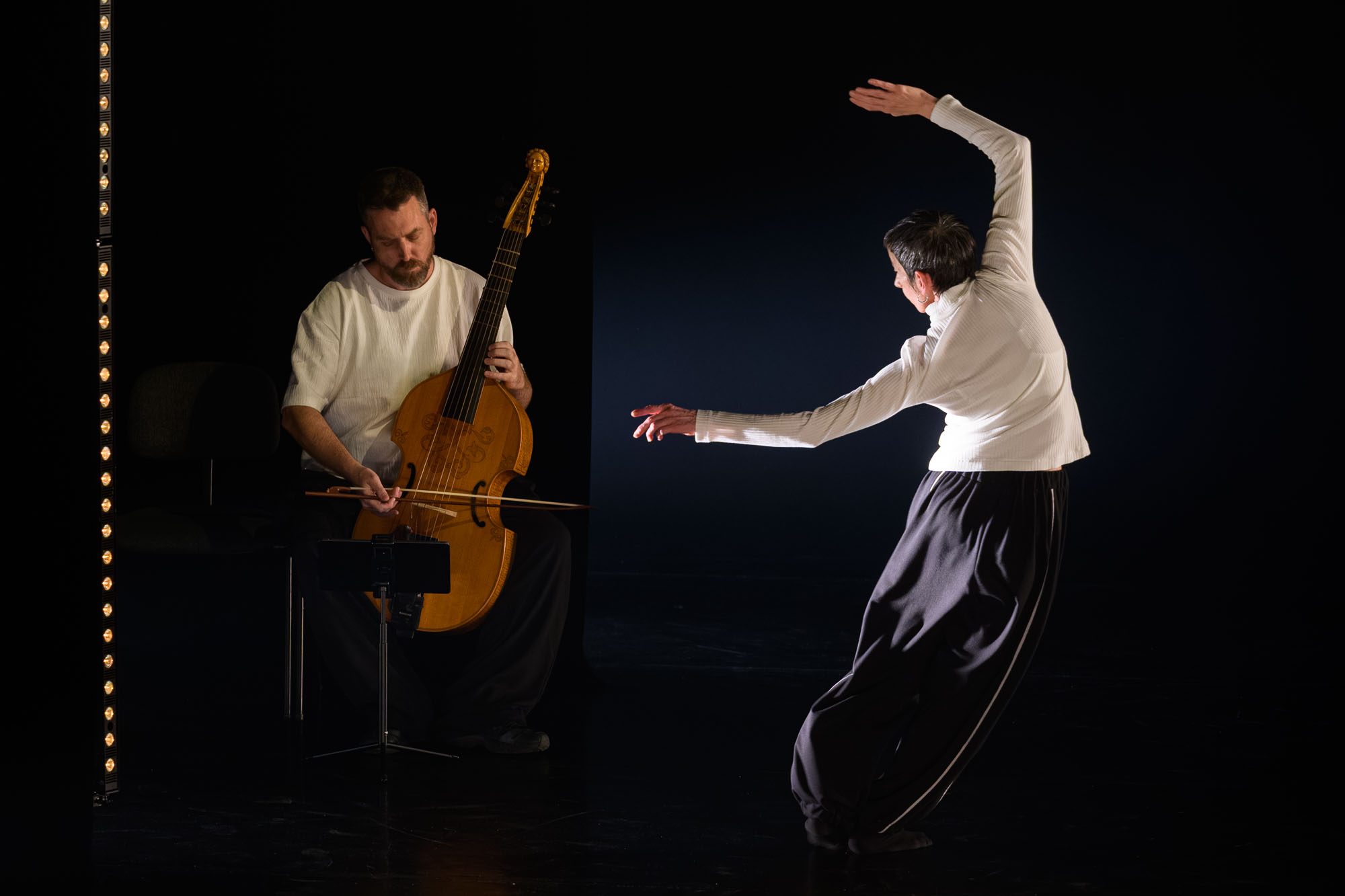
Practicing Efficiency in Motion
How much effort does a movement really need – and what becomes possible when we don’t force it?
This training invites participants to explore an efficiency that comes from a comprehensive understanding of the body: its structure, its weight and its relationship to the floor and to space. It is open to dancers, performers and anyone interested in this approach to movement. Some movement experience is helpful.
The morning unfolds in two parts, beginning by bringing our attention into the body and asking three “how” questions:
How can we let go of unnecessary tension?
How can we use the support of the floor to move with greater ease and efficiency?
And how do we organize our body while moving?
In the first part, we work on the floor with specific, anatomically based exercises. They help us to release unnecessary tension and sharpen our awareness of the structure and complex connections within the body. Here, the floor serves as both partner and support. We look for ways to engage only the amount of muscular effort a movement actually requires. This helps us to shift habitual movement patterns and discover how to move with less effort.
The second part builds on this foundation, continuing to explore skeletal alignment and the support of the floor while standing. We begin with exercises that mobilize the various bones and joints. From there, we focus on the flow of weight and the momentum that arises from it, as well as our relationship to gravity, breath and impulse. We then carry these principles into choreographic material. Rather than forcing movements or focusing on an external form, we work with the underlying logic of each movement: using the weight of the body and its parts, working with falling, letting one momentum arise from another and continually redirecting it through an articulated body – from one movement into the next and out into space. In this way, movement becomes less something we do and more something we allow to happen.
For more than thirty years, laborgras has cultivated a movement practice rooted in American postmodern dance and somatic movement practices. Influenced by long-standing collaborations and mutual exchanges with numerous artists, among them David Hernandez, Rebecca Hilton and Keith A. Thompson, this practice is continually questioned and refined. Since 1996, Renate Graziadei and Arthur Stäldi have taught contemporary dance, improvisation and composition at renowned dance institutions and in international programmes and festivals across Europe, Australia, South America and Asia. The approaches in the training vary depending on the movement material we are currently working on, always aiming to prepare the body to engage with it in an attentive and nuanced way.
Ideally, you leave the studio with a body that feels awake, responsive and ready for the day.
Photo: Phil Dera